
United Broach Company manufactures precision internal broaches for splines, keyways and custom profiles inside bores, engineered for accurate form, chip evacuation and surface finish across demanding industrial applications.
United Broach Company manufactures internal broaches across a wide range of bore diameters and internal forms, supplying automotive, transmission, defence and heavy engineering manufacturers from our ISO 9001:2015 certified facility in Patiala since 2005.
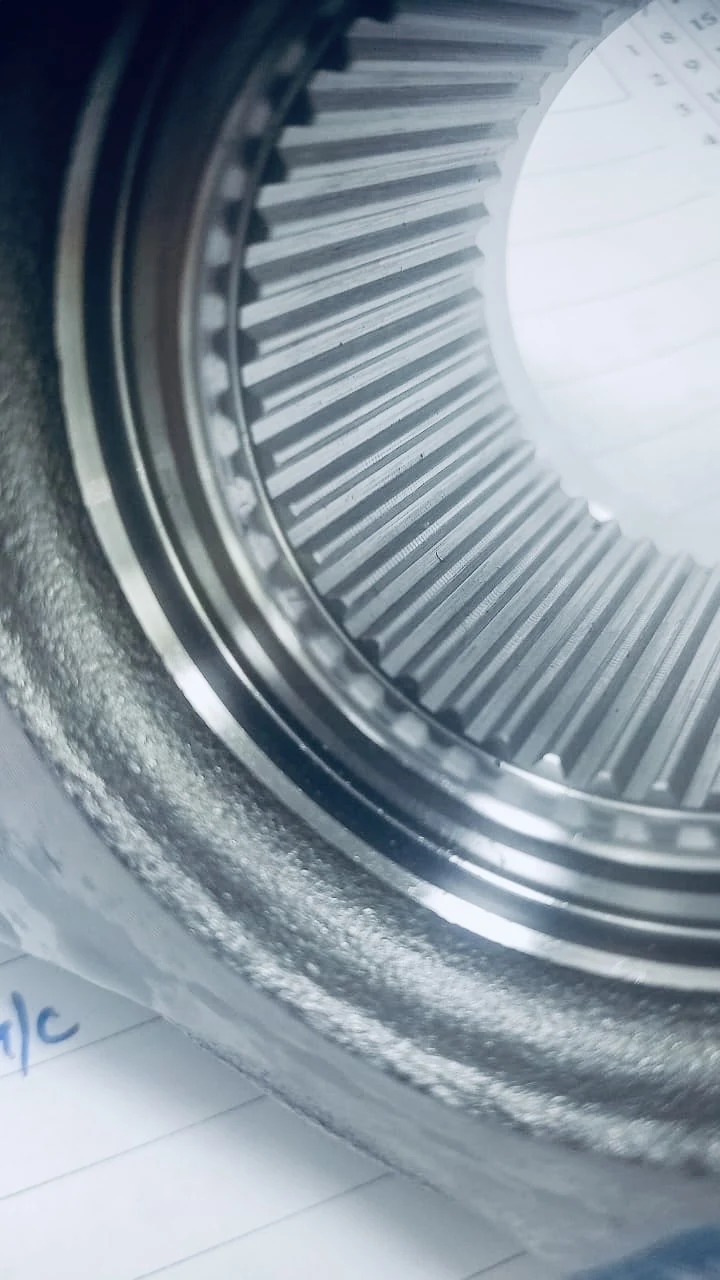
An internal broach is a multi-tooth cutting tool designed to be pulled or pushed through a pre-machined bore, progressively cutting an internal form — a spline, keyway, polygon shape or custom profile — to its final dimension in a single linear pass. Internal broaching is the preferred manufacturing method wherever an internal form must meet tight tolerances on profile accuracy, surface finish and dimensional consistency across high production volumes.
Because the cutting action happens inside an enclosed bore, internal broach design requires careful engineering of chip gullets, pull-force capacity and tool rigidity — considerations that don't apply in the same way to external broaching or open-surface machining operations.
Internal broaching begins with a workpiece that already has a pre-drilled or pre-bored hole, sized to accommodate the broach's starting diameter. The broach — fitted with progressively larger cutting teeth along its length — is then pulled through the bore using a broaching machine, with each tooth removing a thin layer of material until the final, full-size tooth produces the finished internal profile.
Several engineering factors must be addressed in internal broach design:
United Broach Company manufactures internal broaches for a wide variety of internal forms, including involute spline profiles to DIN 5480, straight-side splines to SAE standards, keyways to standard and custom dimensions, polygon bore shapes, and fully custom internal profiles engineered from customer drawings or reverse-engineered from sample components. This breadth of capability allows customers to source multiple internal broaching tool types from a single, ISO-certified supplier rather than managing several specialist vendors.
Internal broaches are manufactured from HSS grades (M2, ASP) for general-purpose and moderate-volume applications, and from solid carbide for high-volume production runs or abrasive workpiece materials where extended tool life between reconditioning cycles is critical to production economics. PVD coatings such as TiN and TiAlN are available to further reduce friction and wear, particularly valuable in continuous high-volume automotive and tractor component manufacturing.
Every internal broach manufactured at United Broach Company undergoes rigorous dimensional inspection using profile projectors, gear tooth measuring equipment and coordinate measuring machines, verifying tooth form, pitch, lead and surface finish against the approved drawing. This inspection discipline is part of our ISO 9001:2015 certified quality management system and ensures consistent performance across every batch of tooling we manufacture.
Internal broaching offers significant advantages over internal milling, shaping or boring for many applications: a single broaching pass can generate the complete finished profile with excellent surface finish and dimensional repeatability, whereas alternative methods often require multiple passes and additional finishing operations. For high-volume production environments — common in automotive and tractor component manufacturing — this translates directly into lower cycle time and more consistent part quality across large production runs.
United Broach Company works closely with customers to understand bore diameter, depth, required internal form and production volume before finalising internal broach design. Our technical team can recommend the most appropriate tool material, coating and tooth progression to balance tool life, cutting speed and surface finish requirements for your specific application, backed by reconditioning support to extend the working life of your tooling investment.
Indicative manufacturing range for internal broaches. Final specification confirmed against customer drawing.
| Parameter | Specification Range |
|---|---|
| Internal Form Types | Splines, Keyways, Polygon Bores, Custom Profiles |
| Bore Diameter Range | Up to 250 mm (application dependent) |
| Broach Length | Up to 2000 mm (application dependent) |
| Tool Material | HSS (M2, ASP grades), Solid Carbide |
| Coating Options | Uncoated, TiN, TiAlN (PVD) |
| Standards Supported | DIN 5480, SAE, ANSI B92.1, Custom Drawing-Based |
| Tolerance Class | As per drawing / AGMA & DIN tolerance grades |
| Surface Finish | Ra 0.4 µm and finer on cutting profile |
| Reconditioning | Available — see Broach Reconditioning Services |
Internal broaches manufactured by United Broach Company are used across critical bore-machining applications.
Internal spline and keyway broaching for transmission gear hubs.
Internal profile broaching for driveline coupling components.
Internal broaching for tractor transmission and PTO bore features.
Precision internal forms for military vehicle transmission components.
Close-tolerance internal profiles for aerospace bushing and coupling parts.
Custom internal forms for heavy engineering gearbox components.
Internal broaching solutions across critical manufacturing sectors.
Two decades of precision internal broach manufacturing, backed by ISO certification and rigorous quality systems.
Quality management systems audited and certified to international standards.
Technical guidance on tool material, coating and tooth progression.
Profile projector and gear tooth vernier verification on every batch.
Tooling supplied internationally under strict inspection norms.
Structured production planning for consistent delivery.
Full reconditioning service to extend internal broach service life.
Common questions about our internal broach manufacturing capability.
An internal broach is a precision cutting tool pulled or pushed through a pre-drilled bore to generate an internal form — such as a spline, keyway or custom profile — inside the workpiece. The tool's progressively sized teeth cut the final geometry in a single linear pass.
We manufacture internal broaches for involute and straight-side splines, keyways, polygon bores, and fully custom internal profiles built from customer drawings or sample components.
Internal broaching cuts a form inside a bore, with the tool pulled or pushed through the hole. External broaching cuts a form on an outer surface, such as a shaft. Internal broaching requires careful attention to chip evacuation, pull-force calculation and fixture design since the cutting action occurs inside a confined space.
Internal broaches are manufactured from HSS grades such as M2 and ASP for general-purpose applications, and from solid carbide for high-volume or abrasive-material production requiring extended tool life.
Internal broach design incorporates chip gullets — spaces between teeth — sized to hold the chip volume generated during the cut. Adequate chip gullet design, combined with correct cutting speed and lubrication, prevents chip packing that could damage the tool or workpiece bore.
Yes. We manufacture internal broaches up to extended lengths to accommodate deep bore applications, with appropriate shank design and rigidity considerations engineered into the tool to prevent deflection during the cut.
Internal broaching is capable of holding tight tolerances on bore diameter, profile form and surface finish, typically tighter than what can be achieved through internal milling or boring in a single operation, which is why it remains the preferred method for high-precision internal spline and keyway production.
Yes. We offer full reconditioning and re-sharpening services for internal broaches to restore cutting edge sharpness and dimensional accuracy, extending the service life of your existing tooling.
Share your bore diameter, internal form requirement and drawing for a manufacturing quote.
Send us your internal broach requirement for a technical evaluation and quotation.