
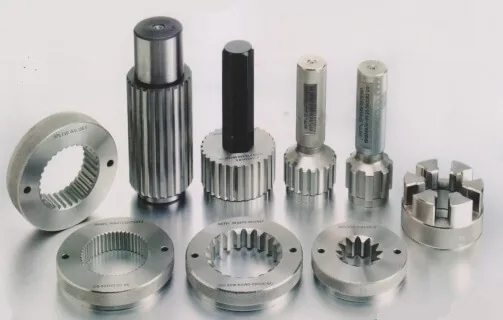
Every broaching tool wears with use, gradually losing the sharpness and dimensional accuracy that made it effective when new. Rather than replacing a worn broach outright, reconditioning offers a cost-effective way to restore the tool to its original cutting specification. This article walks through exactly what happens during the broach reconditioning process, step by step.
In This Article
Why Broaches Need Reconditioning
Every time a broach cuts through a workpiece, its cutting edges experience friction and wear. Over time — and depending on the workpiece material, cutting parameters and production volume — this wear shows up as duller cutting edges, a gradually drifting tooth profile, declining surface finish on the parts being produced, and eventually, parts that begin to fall outside their tolerance specification. Reconditioning addresses this wear directly, through precision regrinding that restores the tool's geometry and cutting performance.
Step 1: Incoming Inspection
The reconditioning process begins with a thorough inspection of the broach as received. The tool is measured against its original specification — drawing data if available, or measured reference data derived from the tool itself — to assess the wear pattern and determine exactly what reconditioning work is needed. This step also identifies whether the tool has sufficient remaining material to support another regrinding cycle, or whether it has reached the end of its useful reconditioning life.
Step 2: Cleaning & Preparation
Before any grinding work begins, the broach is thoroughly cleaned to remove accumulated residue, oils and any remaining coating if a recoat is planned. This preparation step ensures the regrinding process works against a clean, consistent surface and that subsequent measurements are accurate.
Step 3: CNC Profile Regrinding
This is the core of the reconditioning process. Using CNC grinding equipment, the worn cutting teeth are precisely reground to restore the correct tooth form, relief angles and sizing dimension. The grinding parameters are set based on the incoming inspection data, targeting a return to the original drawing specification rather than simply removing the minimum material needed to sharpen the edges. This careful, specification-driven approach is what separates professional reconditioning from a simple "sharpen and hope" regrind.
Have A Worn Broach That Needs Reconditioning?
United Broach Company offers professional reconditioning services for spline, keyway, internal and profile broaches — regardless of original manufacturer.
Learn About Our Reconditioning ServiceStep 4: Heat Treatment Verification
After regrinding, hardness is verified to confirm the tool retains adequate wear resistance for continued use. Grinding generates heat at the cutting edge, and in some cases additional heat treatment steps may be required to ensure the regrund surface maintains the correct hardness profile expected for the tool steel grade in use.
Step 5: Final Inspection
Once regrinding and any necessary heat treatment steps are complete, the reconditioned broach undergoes the same rigorous inspection process applied to newly manufactured tooling. This typically includes profile projector verification of tooth form, gear tooth vernier measurement of pitch and lead (for spline broaches), and height gauge checks for more complex profiles. Only once the tool is confirmed to meet the original tolerance specification is it approved and prepared for return to the customer.
Step 6: Optional Recoating
For customers looking to extend tool life beyond the broach's original specification, PVD coatings such as TiN or TiAlN can be applied as a final step in the reconditioning process. These coatings reduce friction and improve wear resistance, often allowing the reconditioned tool to outperform its original uncoated state in terms of cycles before the next reconditioning is needed.
The Economics Of Reconditioning
For most customers, reconditioning costs a fraction of manufacturing a brand new replacement broach, while fully restoring cutting performance. For production operations running multiple broaching tools across various stations, scheduling reconditioning proactively — before a tool fails completely — helps avoid unplanned downtime and the risk of producing out-of-tolerance parts. Many customers establish a standing reconditioning arrangement, rotating tools through scheduled regrinding cycles that fit around their production planning, rather than waiting for a tool to fail before sending it for restoration.
The number of times a broach can realistically be reconditioned depends on its original design margin — specifically, how much extra material was built into the tooth height to allow for future regrinding cycles. A broach designed from the outset with reconditioning in mind can often support multiple regrinding cycles before reaching the end of its usable life, making the upfront tooling investment even more cost-effective over the long run.
Signs It's Time To Send A Broach For Reconditioning
Rather than waiting for a tool to fail outright, most experienced production teams watch for early warning signs: a gradual decline in surface finish on parts coming off the line, a noticeable increase in cutting force or cycle time, visible dulling or light chipping on the cutting edges during routine inspection, or dimensional checks that show parts trending closer to the edge of their tolerance band even though nothing else in the process has changed. Catching any of these signs early and scheduling reconditioning proactively almost always produces a better outcome — both in terms of cost and in avoiding a batch of out-of-tolerance parts — than waiting until the tool fails completely.
Sending a broach for reconditioning at the first sign of wear — rather than waiting until it fails completely — typically results in a more cost-effective restoration and protects part quality on the production line.
Related Reading
To understand more about how broaching tools are designed and manufactured in the first place, see our guides on what a spline broach is and internal spline manufacturing. If you're weighing up broaching against an alternative process for a new component, our broaching vs milling comparison covers the key trade-offs.