
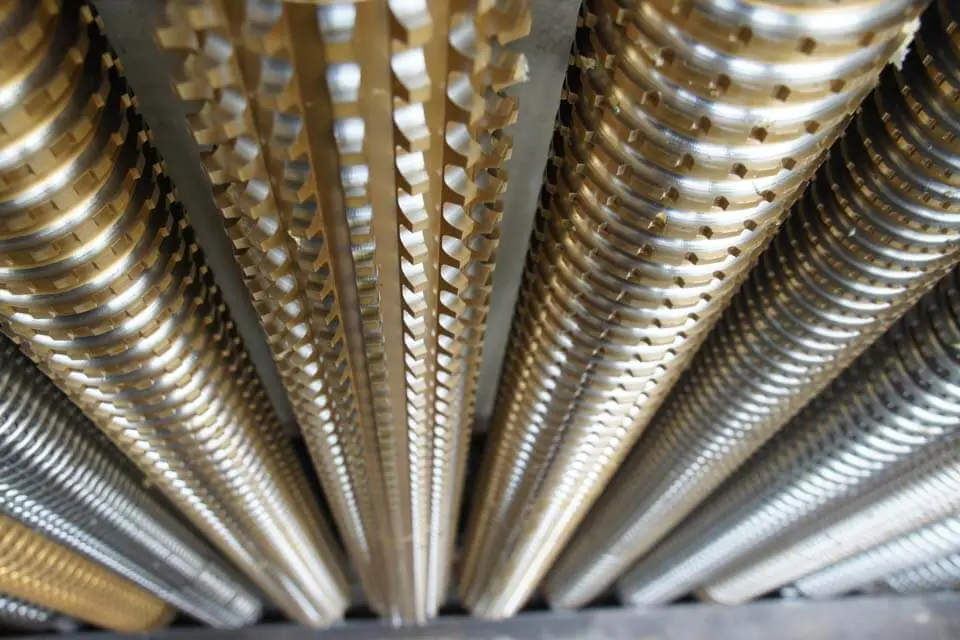
Internal splines appear in countless mechanical assemblies — gear hubs, couplings, clutch plates, universal joints — wherever a rotating component needs to be locked to a shaft inside a bore. This guide walks through the practical considerations involved in manufacturing internal splines, from selecting the right standard through to managing the engineering challenges unique to internal broaching.
In This Article
What Is An Internal Spline?
An internal spline is a series of ridges or teeth machined into the inside surface of a bore, designed to mate with a corresponding external spline on a shaft. Together, the internal and external spline form a connection capable of transmitting significant rotational torque while, in many designs, still permitting some axial sliding movement between the two parts. This makes splines especially useful in applications like transmission gear hubs, where a gear must rotate with the shaft but may also need to slide along it during gear changes.
Selecting The Right Spline Standard
The first decision in any internal spline manufacturing project is which standard — or custom specification — the spline must conform to. DIN 5480 defines involute spline profiles widely used in European and Indian automotive and industrial applications, specified by module, pressure angle and tooth count. SAE straight-side spline tables are common in North American tractor and off-highway equipment. ANSI B92.1 covers American involute spline applications. Where a component doesn't match any of these standards — often the case for proprietary product designs — a fully custom profile must be engineered from the customer's drawing.
Choosing the correct standard isn't just a paperwork exercise: it determines the tooth form, pressure angle, fit class and ultimately whether the finished component will mate correctly with parts from other suppliers in the same supply chain.
Need An Internal Spline Broach Engineered For Your Application?
United Broach Company designs and manufactures internal spline broaches to DIN 5480, SAE, ANSI and fully custom specifications.
View Our Internal Broach CapabilityInternal Spline Broach Tooling Design
Designing an internal spline broach involves determining the tooth progression — how much material each successive tooth removes — balanced against cutting force, tool life and surface finish requirements. Roughing teeth remove the bulk of the material in larger increments, semi-finishing teeth refine the profile closer to final dimension, and the final sizing teeth cut the exact finished spline form. Getting this progression right is a balance: too aggressive a cut per tooth increases cutting force and reduces tool life, while too conservative a progression makes the broach unnecessarily long and expensive.
Tool material selection also matters significantly. HSS grades such as M2 and ASP offer good toughness for general-purpose and moderate-volume applications, while solid carbide construction extends tool life for high-volume or abrasive-material production, at a higher upfront tooling cost.
Chip Evacuation & Cutting Fluid
Because internal broaching happens inside an enclosed bore, managing the chips generated during cutting is a critical design consideration that doesn't apply in the same way to external broaching or open-surface machining. Chip gullets — the spaces between teeth — must be sized to hold the volume of material removed during each pass without packing, which could otherwise damage the tool or scar the bore surface.
Effective cutting fluid delivery to the confined cutting zone also plays an important role, both in flushing chips out of the bore and in cooling the cutting edges to extend tool life and improve surface finish on the finished spline.
Fixturing & Pull-Force Considerations
The broaching machine must be capable of generating sufficient force to pull (or push) the broach through the workpiece material being cut, and the broach itself must be designed to withstand that force without excessive deflection or risk of breakage. For longer broaches — needed for deeper bores — shank design and overall tool rigidity become increasingly important, since any deflection during the cut directly translates into profile inaccuracy on the finished spline.
Proper workholding is equally important: the workpiece must be securely fixtured to prevent any movement during the cutting stroke, which would otherwise introduce positional errors in the finished spline relative to other features on the component.
Quality Control For Internal Splines
Verifying an internal spline's accuracy typically involves a combination of dedicated spline gauges for fast pass/fail checks on the production floor, and more detailed measurement using gear tooth verniers, optical profile projectors or coordinate measuring machines for process validation and periodic audits. Key parameters checked include tooth form, pitch diameter, lead accuracy and surface finish, all verified against the governing standard or customer drawing.
Common Manufacturing Issues & How To Avoid Them
Several recurring issues can affect internal spline manufacturing quality: chip packing inside the bore due to inadequate gullet design or poor lubrication, tool deflection on longer broaches causing taper or inconsistent profile along the spline length, premature tool wear from incorrect material selection for the application's production volume, and dimensional drift over a production run as the broach gradually wears without being reconditioned at the appropriate interval. Most of these issues are preventable through careful tooling design upfront and a structured reconditioning programme to catch wear before it affects part quality.
Internal spline broaching rewards careful upfront engineering — chip gullet design, pull-force calculation and tool rigidity all need to be right before the first part is ever cut.
Related Reading
For a broader introduction to spline broaching fundamentals, start with our guide on what a spline broach is. If you're deciding between broaching and an alternative manufacturing process, see our broaching vs milling comparison. And if your internal spline broach is showing wear, our article on the broach reconditioning process explains how to restore it to specification.