
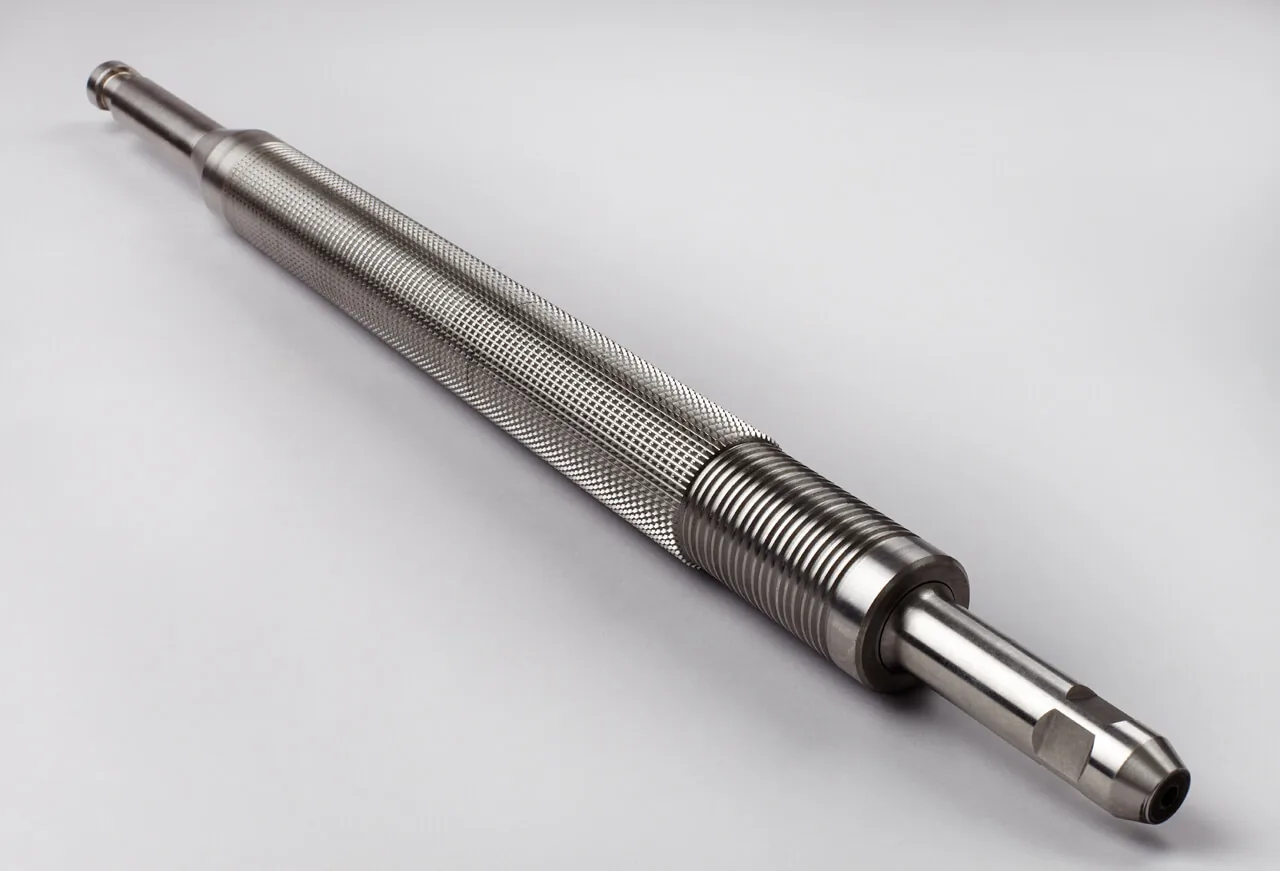
If you work in automotive, tractor, or transmission component manufacturing, you've almost certainly encountered the term "spline broach" — but what exactly is it, and why does it matter so much to the parts that depend on it? This guide breaks down what a spline broach is, how it works, and why it remains the preferred manufacturing method for producing splines across countless mechanical assemblies.
In This Article
What Is A Spline Broach?
A spline broach is a precision cutting tool used to generate a spline — a series of ridges, teeth or grooves — on the internal surface of a bore or the external surface of a shaft. Splines allow two mating components to lock together rotationally while still permitting axial movement in many designs, making them essential wherever torque needs to be transmitted reliably between a shaft and a hub, gear, or coupling.
Unlike a single-point cutting tool, a spline broach carries a whole series of teeth along its length, with each tooth slightly larger than the one before it. As the tool is pulled (or in some configurations, pushed) through the workpiece in a single linear stroke, each tooth removes a thin layer of material, progressively building up the spline profile until the final tooth — known as the sizing tooth — cuts the finished, full-depth spline form.
How Spline Broaching Works
The broaching process for splines typically follows this sequence:
- Workpiece Preparation — For internal splines, a pilot bore is pre-drilled or pre-bored to a diameter that matches the broach's starting size.
- Tool Engagement — The spline broach is fed into the bore (or positioned against the shaft for external splining) and engaged with the broaching machine's pulling or pushing mechanism.
- Progressive Cutting — As the broach moves through its stroke, each successive tooth removes a small, controlled amount of material.
- Sizing Pass — The final teeth on the broach are sizing teeth, cut to the exact finished dimension, producing the completed spline profile with no further machining required.
- Part Removal & Inspection — The finished component is removed and periodically checked using spline gauges to confirm the profile meets specification.
This single-pass approach is what gives broaching its key advantage: excellent dimensional consistency and surface finish achieved in one operation, rather than requiring multiple machining steps as is often the case with milling or shaping.
Types Of Spline Broaches
Spline broaches are generally categorised along two dimensions: where the spline is cut, and the shape of the tooth profile.
Internal vs External Spline Broaches
Internal spline broaches cut the spline profile inside a bore — for example, inside a gear hub or coupling. The tool is pulled through the pre-bored hole, with chip evacuation and pull-force capacity being important design considerations given the confined cutting environment.
External spline broaches cut the spline profile onto the outside surface of a shaft. These tools are common in tractor PTO shaft manufacturing and various automotive steering and driveline applications, where rigid workholding and alignment are critical to prevent deflection across the length of the cut.
Involute vs Straight-Side Spline Profiles
Involute splines have a curved tooth profile similar to gear teeth, providing self-centring properties and good load distribution. These are common in European and Indian automotive applications, typically specified to DIN 5480.
Straight-side splines have teeth with parallel flat sides rather than a curved involute form. These are widely used in North American tractor and agricultural equipment, typically specified to SAE standards.
Spline Standards & Specifications
Spline broaches are manufactured to match recognised industry standards, ensuring that mating components from different suppliers will fit together correctly. The most common standards include DIN 5480 for involute splines, SAE straight-side spline tables for tractor and off-highway applications, and ANSI B92.1 for American industrial and automotive applications. Many manufacturers also require fully custom spline profiles for proprietary product designs, in which case the broach is engineered directly from a customer drawing rather than a published standard.
Need A Spline Broach For Your Application?
United Broach Company manufactures internal and external spline broaches to DIN 5480, SAE, ANSI and fully custom specifications from our ISO 9001:2015 certified facility in Patiala.
View Our Spline Broach CapabilityMaterials Used In Spline Broaches
Most spline broaches are manufactured from high speed steel (HSS) grades such as M2 or ASP, offering a good balance of toughness and wear resistance for general-purpose and moderate-volume applications. For high-volume production or abrasive workpiece materials, solid carbide construction is often used to extend tool life between reconditioning cycles. PVD coatings such as TiN and TiAlN are commonly applied to further reduce friction and wear, particularly valuable in continuous automotive and tractor production environments.
Why Spline Broach Accuracy Matters
The spline connection in any assembly is a load-bearing interface. If the broach producing that spline is out of tolerance — even slightly — the result can be uneven load distribution across the spline teeth, accelerated wear, increased backlash, noise (particularly problematic in transmission and steering systems), and in severe cases, fatigue failure of the mating components. This is precisely why automotive, tractor and aerospace manufacturers maintain strict supplier qualification processes for spline broach tooling, and why dimensional inspection is built into every stage of the broach manufacturing process.
Choosing The Right Spline Broach For Your Application
Selecting the correct spline broach involves several considerations: the spline standard your component must meet, whether the spline is internal or external, your production volume and expected tool life requirements, the workpiece material, and any space or length constraints from your broaching machine. Working with a manufacturer who can advise on these factors — rather than simply supplying a catalogue part — often leads to better tool performance and lower total cost over the life of the tooling.
If your spline geometry doesn't match a standard catalogue profile, it's worth exploring custom profile broach manufacturing as an alternative, which allows for fully proprietary spline and tooth forms engineered from your drawing or sample component.
Splines are a load path. The precision of the broach that cuts them directly determines the strength, noise behaviour and service life of everything downstream of that connection.
Related Reading
To deepen your understanding of spline manufacturing, explore our companion guide on internal spline manufacturing, or compare broaching against alternative processes in our broaching vs milling guide. If your existing spline broach is showing signs of wear, our article on the broach reconditioning process explains how reconditioning can restore cutting accuracy without the cost of a full tool replacement.