
When a component requires an internal or external profile — a spline, keyway, or special form — engineers often face a choice between broaching and milling. Both processes can produce the required geometry, but they differ significantly in tolerance capability, surface finish, cycle time and tooling economics. This guide walks through the key differences to help you choose the right process for your application.
In This Article
Process Overview
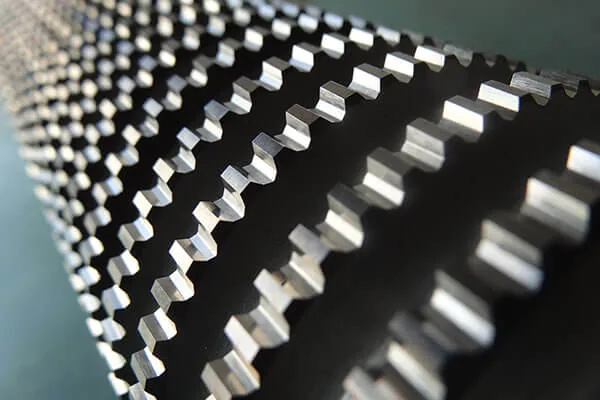
Broaching uses a multi-tooth linear cutting tool, pulled or pushed through (or over) a workpiece in a single stroke. Each tooth on the broach is progressively larger than the last, so the complete profile is generated incrementally as the tool passes through, with the final tooth cutting the finished dimension.
Milling uses a rotating cutter that follows a programmed tool path across or around the workpiece, removing material through multiple passes or a continuous contouring motion. For internal or external profile features like splines and keyways, this typically means the cutter must trace the full profile shape, often requiring several passes to reach final depth and finish.
Tolerance & Dimensional Accuracy
Broaching tends to outperform milling on dimensional consistency across a production run. Because the broach's final sizing teeth are ground to the exact finished profile, every part that passes through the tool receives essentially the same geometry, assuming the tool remains sharp and the machine is properly set up. Milling accuracy, by contrast, depends heavily on machine rigidity, tool wear compensation, and the skill of the programming — small deviations can accumulate across a multi-pass milling operation in ways that are less likely with a single-pass broaching stroke.
For applications with tight tolerance requirements — such as automotive transmission splines or aerospace components — this consistency advantage is often the deciding factor in favour of broaching.
Surface Finish
Broaching typically produces a superior surface finish in a single pass compared to milling, because the sizing teeth are specifically ground to finish the surface as the final cutting action. Milling can achieve excellent surface finish too, but often requires a dedicated finishing pass after roughing, adding to cycle time. For internal splines and keyways where surface finish directly affects fit and wear characteristics, broaching's single-pass finish quality is a significant practical advantage.
Considering Broaching For Your Component?
United Broach Company manufactures precision spline, keyway, internal and profile broaches engineered for your specific tolerance and production volume requirements.
Explore Our Broaching CapabilityCycle Time & Production Volume
For high-volume production of repetitive features like splines and keyways, broaching is generally faster per part. The entire profile is generated in a single linear stroke, whereas milling a similar feature often requires the cutter to trace the profile through multiple passes, particularly for deeper or more complex geometries. This makes broaching the preferred choice for automotive and tractor component manufacturing lines producing thousands or tens of thousands of identical parts.
For low-volume or prototype work, however, the equation can shift. A dedicated broach represents a significant upfront tooling investment that only pays off across a sufficient production volume. Milling, using more general-purpose tooling and CNC programming, can be more economical when only a handful of parts are needed.
Tooling Cost Considerations
A custom broach is typically more expensive to manufacture upfront than the general-purpose end mills or form cutters used in milling, because the broach must be precisely engineered and ground for one specific profile. However, this upfront cost is amortised across the entire production run — for high-volume applications, the lower per-part cycle time and superior consistency of broaching often result in a lower total cost per part compared to milling, once tooling cost is spread across the production volume.
Broaching tools can also be reconditioned multiple times throughout their service life, further improving the economics of the upfront tooling investment compared to consumable milling cutters that are typically replaced rather than reground.
When To Choose Each Process
As a general guide:
- Choose broaching for high-volume production of standard or custom spline, keyway, or profile features where tight tolerance and consistent surface finish are priorities, and where the production volume justifies the upfront tooling investment.
- Choose milling for low-volume or prototype work, highly variable geometries across different parts, or situations where a CNC milling setup is already available and a dedicated broach isn't yet justified by volume.
In practice, many manufacturers use both processes at different stages of a product's lifecycle — milling for prototype and early production runs, transitioning to broaching once volume justifies the investment in dedicated tooling.
A Practical Decision Framework
If you're trying to decide between the two processes for a specific component, it helps to walk through a few practical questions: How many parts will you produce per year, and over how many years? Is the geometry standard (a recognised spline or keyway form) or fully custom? What tolerance and surface finish does the application demand? And do you already have broaching or milling capacity available, or would either choice require new capital equipment?
Answering these questions honestly usually points clearly toward one process or the other. A component with a standard DIN 5480 spline profile, a production volume in the thousands per year, and tight noise/vibration requirements is almost always a broaching application. A one-off prototype with a complex, evolving geometry is almost always better suited to milling until the design stabilises.
Broaching's single-pass approach trades upfront tooling cost for downstream consistency, speed and finish — a trade that pays off the moment production volume crosses a certain threshold.
Related Reading
To understand more about how broaching tools are engineered for specific applications, read our guides on what a spline broach is and internal spline manufacturing. If you already use broaching and want to extend the life of your existing tooling, see our explanation of the broach reconditioning process.